I Didn’t Mean to Have a Spooky Sunday

June 30, 2015 — I didn’t mean to have a spooky Sunday. I’m not sure what did it. But I am blaming it on the Halloween Kit Kat.


Sunday I had an appointment for my current book project in New Preston, Connecticut, about two and a half hours from my house. Now, the book project is Halloween-flavored, so that might have at least contributed a mindset. Also relevant was that it was raining hard and the temperature was in the 60s—I’m talking real candy corn bowl and spiced pumpkin candle weather—despite the fact I was on the July edge of June.

So it was going to be one of those days. I had no clue it was going to be one of those days, though.


I first stopped at my local gas station—the one that between the gas and the snacks and the booze, I’m pretty sure takes more of my paycheck than taxes—to fuel up for the trip. While there, I picked up a roadtrip breakfast: Tabasco Slim Jims and a Coke Zero. At the counter, there was a couple of Halloween Kit Kats in a rack of otherwise in-season candy. The package was orange with black bat wings behind the logo and phrases printed on it like, “1 of 4 spooky bar designs” and “Dare to find what’s inside.” It was all I could do to not expand my definition of a roadtrip breakfast.

I didn’t buy one. But for some reason, I did take a picture. That was enough to tint my day, to send me off through the jack-o-lantern-shaped door in the forest. Because, 20 minutes or so later, I passed this:

Taken fumblingly through a rainy window at Interstate speeds. Like I said,
I didn't mean to have a spooky Sunday.'

We all have those in our towns, remnants of Halloween celebrations past. Or future too, I guess. But that’s when I gave in. It was going to be Halloween for the next few hours. I was alone on this trip, and needed something to occupy myself, anyway.


Now, the reason I have a Halloween mix-CD in my car is because, well, I have a bunch of CDs in my car. And the reason I have that is because I have a six-CD changer. That’s going to be gibberish to a lot of you, but just let me tell you that it really impressed the girls back in the day. My car turned a decade this year, and we’ve been on too many jaunts together for me to trade it in for something I can plug a smartphone into.

Most of the trip was bland highway, so eventually I wondered if I was forcing things. I mean, sure some old candy and an old sign and some unseasonable weather didn’t give me license to Fall. Plus I’d just done a Halloween Day a few weeks ago. This thought particularly invaded me once I left the highway and found myself driving around a random cemetery merely because Elvira was rapping about monsters over my speakers when I passed it.


So I got back in my ten-year-old car, sheepishly swapped out the CD for some Kris Kristofferson collection and drove a little farther. And saw this:


Now there were no reason for this pizza place to have a pair of skeletons and a cauldron-y looking black bathtub so prominently on their roof. None. It’s not part of their theme. Maybe it was left over from Halloween, but unless you’re a family-run convenience store at the bottom of New Hampshire doing a decent profit off my cash, that’s a business no-no. The only explanation is that I’d entered a Halloween zone. A parallel set of roads than the ones I started out on. Sure, they were taking me to the same place, just by way of October.

I mean, the only thing that would’ve made this more perfect is if one of the many farm stands and garden centers I passed had left out their pumpkin signs. Didn’t happen, unfortunately, but I did see a few monsters.

Like this lake monster:


And a minotaur:


Finally, I arrived at New Preston, which if you follow me on social media, you know is the town where they filmed almost all of Friday the 13th, Part 2. That’s the sack-headed Jason Voorhees, in case you’re not the scholarly type. The photo below is the town center, which 35 years ago was the exact setting for the scene near the beginning where the ill-fated Crazy Ralph warns the ill-fated teenagers of their doom and then their ill-fated friends play a trick on them by towing their car around the bend.


The site has changed only a little, a gas station and a phone booth are gone, and the stores are all antique shops now, but the basic geography of the scene is intact.

Most important, it was the perfect place to end a Halloween roadtrip. Someday I’ll tell you about the return leg, where I accidentally Christmas’d.


The Book Ends on Ray Bradbury's Home

Photo credit: Reuse People of America
June 23, 2015 — In January of this year, much to the horror of Ray Bradbury fans such as myself, the late author's iconic Los Angles home was torn down to make way for a new house. At the time, I posted my conflicted and in-the-moment thoughts on the loss here.

Well, apparently, its bones didn't all go into the dumpster. A group called the ReUse People of America salvaged its pieces for re-sell on the building supplies market. So maybe your future house will get a light fixture that nightly illuminated Bradbury's reading or a faucet that spent most of its life washing typewriter ribbon ink off his hands. More relevantly, the group decided to turn some of the 2x6 Douglas fir boards from the house into bookends in honor of the author to sell to Bradbury fans. According to its website:

Each bookend set is branded with a series number and the icon "451 F", to commemorate Bradbury's best-seller, Fahrenheit 451. Sets are accompanied by a thank-you letter from The ReUse People (TRP), the company responsible for salvaging the material, and a certificate of authenticity signed by Alexandra Bradbury, the late author's daughter, and TRP President Ted Reiff. 

I've been checking the site daily for weeks for them to start selling the bookends, and they finally released them today. The bookends are going for $88.50 a set, including shipping and handling. You can buy them here.

They were made by a Los Angeles furniture company called Saint Arbor, and I'm really digging the design. They kept the bookends rough to show that the sets were obviously repurposed from something else.

Even better, part of the money raised from the sale of these bookends is going to the Center for Ray Bradbury Studies at Indiana University to help fund their ongoing project of recreating Bradbury's wonder-full home office.

The only thing is that they've limited the run to 451 sets, so they will run out at some point. Although I have direct knowledge that there are at most 449. I bought two sets already.

Anyway, I'd suggest getting the bookends while they're at the temperature at which books burn.

UPDATE: Got mine. And apparently they're sold out, so there go my dreams of buying
enough sets to rebuild his house.


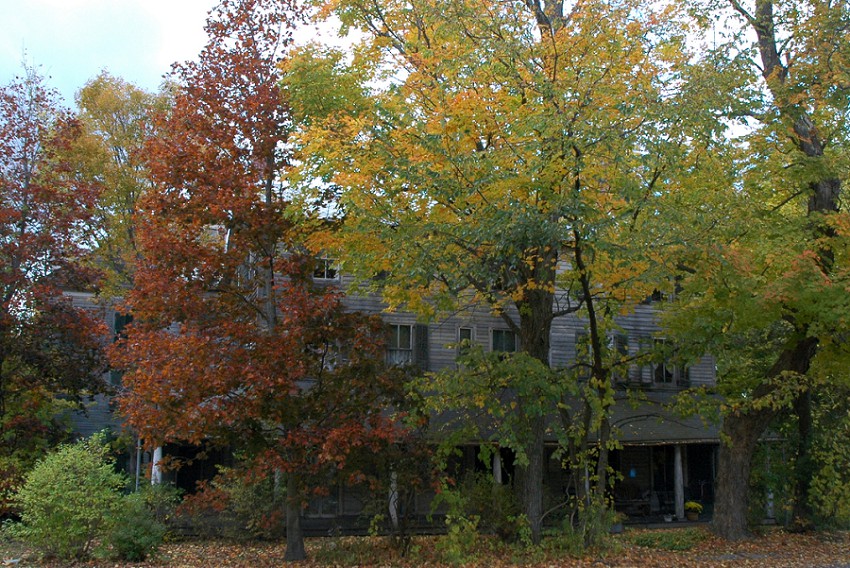
Before the Cannibals: The Walloomsac Inn, 1983

Credit: Scott Philbrick, 1983
June 23, 2015 — In 1983, Scott Philbrick was 19 years old and starting to get interested in photography. That autumn, he got the opportunity to travel from his home in New Hampshire to the Rensselaer Polytechnic Institute in Troy, New York, to help his mentor—the late Michael Glynn—set up a photography show there. Along the way, they passed an inn in Bennington, Vermont, and took a few shots, for no other reason than that it seemed striking. It was a brief stop, and Philbrick quickly forgot ever setting foot in Robert Frost’s death town.

Until this past Father’s Day, when his son Samuel had a few rolls of Philbrick’s unlabeled negatives digitized as a surprise. In those images, Philbrick found two photos of a large, worn-looking building bearing a sign on the front that designated it the Walloomsac Inn. Or at least the WaXXoomsac Inn, thanks to a tree trunk in the front yard that obscured part of the sign. Curious, he Googled what he could see of the name and found the images of the anonymous, decrepit pile of haunted gray timber that the inn is today.

Credit: Scott Philbrick, 1983

And they were OTIS images, from a 2012 post about my 2009 visit. So Philbrick sent his 1983 Wallomsac Inn photos to me, knowing I would dig them. And I do. I mean, that’s the fabled Walloomsac Inn three decades ago, looking not at all like the ancestral home of elegant cannibals or however I categorized it in that post.

For whatever reason, that Walloomsac Inn post is one of the more popular ones on OTIS. Actually, for obvious reasons. The place looks like history and tragedy and mystery incarnate. And seeing how it appeared in 1983 just adds to all three.

So, thanks, Samuel, for preserving your father’s work and thanks, Scott, for sending these along. And here’s to whoever takes photos of the place in 30 more years.

Credit: OTIS, 2009
Credit: OTIS, 2009
Credit: OTIS, 2009


Fall in the Sea, Eventually: 2015 Hampton Beach Sand Sculptures


June 21, 2015 — Sometimes I want to do something without doing something. And visiting a sand sculpture competition fits that anti-desire perfectly. You hit the beach without hitting the beach. Check out some art without getting into the mindset of checking out art. Then you buy some funnel cake and head home to nap-watch edited cable movies the rest of the day because you’re quota of being active for the weekend was hit exactly.


New Hampshire has a very short ocean coast, and Hampton Beach is its one real beach town. Each year it invites about a dozen sculptors from across the U.S. and Canada to incarnate specially imported sand into something to attract cameras, all while surrounded by greasy, near-naked people who need something to do while they avoid the perpetually chilly waters of a New England beach. Winners split a purse of $15,000, and everybody gets a sun burn.

The sculptures are on view from the boardwalk, so you can avoid getting sand in your shoes, while event sponsors like McDonald’s hand out coffee in a tent shaped like a giant Happy Meal and people in blue Geico shirts stand in the shadow of a 9-foot-tall inflatable gecko cajoling people into signing up for a raffle.


My favorite sand sculpture this year, the seemingly H.R. Giger-inspired Entangled by Guy-Olivier Deveau of Kansas (just kiddingQuebec), came in second place. It was actually a horror sand sculpture that turned me on to the event back in 2012, when somebody created an awesome piece in homage to John Carpenter’s The Thing. There’s something about a beige abomination sitting placidly on a sunny beach surrounded by bikinis and volleyball nets that makes me happy.


The sculptures are supposed to be up through the first week of July, and are lit at night. But for those who are okay with instead seeing them two-dimensionally from their cellphone, here’s some sand posing in extremely non-sandy ways.

Together in the Game of Fate

Twisted

BFF's :)
Winner of the People's Choice Award.

Leap of Faith

Sucker Punch
Winner of the Sculptor's Choice Award

Life
First Place Winner. Apparently, and I didn't notice it at the time,
but the back of the sculpture depicts an old man.

Role Play
Third Place Winner


Flower Power

The only one I missed a photo of was the Native American-themed American Spirit. Also, bonus fun-fact: I had to straighten the watery horizons on every one of these photos in post. Just a crooked, crooked man.


Strolling to a Hell Vent: The Poás Volcano


June 18, 2015 — We could smell it before we saw it, that sulfurous stink heavy on the air, like the land itself had gone bad. And it kind of had. We were walking toward a hot pustule on the Earth’s surface known as the Poás Volcano.

The ring of fire cuts an arc through Coast Rica, blistering the country with some 60 or 70 volcanoes, about a half dozen of which are active. Poás is one of the latter. But that’s not why we chose it. Poás was just the most convenient volcano, a phrase I love to death and, according to Google Search, isn’t used enough in the world.

Poás is about 30 miles north of San Jose, and it took us about an hour and a half to get there on San Jose’s notoriously slow roads. From the parking lot and visitor center, though, it was a mere quarter-mile stroll up a paved path to the viewing area. Like I said, a convenient volcano.


Because of the geography of the landscape, we never saw a cone or anything dramatic from afar. We just passed the evacuation instruction signs set up “in case of volcanic activity” and the warnings for those with asthma or hypertension to limit their time there, walked up to the guardrail, and gazed into its massive maw.

Which we couldn’t see.


At first I didn’t understand. We had timed it right, purposefully arriving early to both avoid the large crowds (it’s a convenient volcano) and because at most times of day the volcano is obscured by fog emanating from the surrounding cloud forest. The morning is the best chance to see it.

Turns out, Poás was just saying hello.

I’d been to volcanoes before, Mount St. Helens in Washington and Mount Vesuvius in Italy. Although both are technically active volcanoes, neither was stirring on our visits, the former being all snow-capped and serene and the latter cloud-capped and crowded.

Besides a few rumbles here and there, Poás itself hadn’t done any impressive erupting since the 1950s. But what I at first took to be fog was actually gas and steam spewing from its fumaroles. This thing was putting on a little show. Fortunately, every once in a while the smelly whiteness would abate or the wind would change, and we got a clear view deep into the monster.


The Poás crater is about a mile wide and about a thousand feet deep. In its center is a small lake called Laguna Caliente—Hot Lagoon. It’s extremely acidic, devoid of life, probably tastes good on fries. In photos online, it appears pale green, but on our visit it was colorless, almost shiny, like a pool of mercury. I assume from all the steam reflecting in it. The lake does have a layer of liquid sulfur on its bottom, so don’t dip your fries too deep.


Once we’d had all the sulfur smell we could stomach, we took the long way back to the parking lot through the cloud forest. We saw zero of the much-promised bountiful wildlife along the mile-long loop of trail, but we did see Laguna Botos. Unlike Laguna Caliente, this lake filled an inactive crater and was in an idyllic setting cozied about by the forest, although it was still highly acidic.


Overall, Poás Volcano National Park is a strange combination of easy, pleasant tourism and a great potential for inhospitability, like volcano eruptions and acid rain.

As we left, the cloud forest fog was rolling in, making the visitor center a hazy-looking figment and ensuring that the volcano crater would be invisible to those unlucky enough to mistime their visit. Sometimes Poás is an inconvenient volcano.

But at least they could still smell it.


To Dog Be the Glory: The Dog Chapel


June 10, 2015 — I don’t remember the day in my childhood when I discovered that “god” and “dog” are anadromes. Young enough not to know about the word “anadrome,” I assume. Still, I do remember how much fun it made church for a while after. Little did I know that a few decades later I’d walk into a church dedicated to the canine species.

The Dog Chapel in St. Johnsbury, Vermont, looks like your classic New England church—stark white with a pointy steeple that goes perfectly against hills covered in fiery autumn foliage. I was there on an drab, overcast spring day, but you know what I mean. There are a few tip-offs that this isn’t your average New England church.


First, it’s small. Like a little bit bigger than the square footage of a two-car garage. But, like they say, it’s not the size of your church. However, it’s the second thing that really catches your attention: The group of painted wooden sculptures in front of it. A man in a suit stands surrounded by dogs of various breeds outside the church like the analogy is alpha male and pack instead of shepherd and flock. Beside them, on a sign where a real church would have a Bible verse or a denunciation of any of a range of the more fun things in life, it says “All Creed, All Breeds, No Dogmas.”


It looked like a nice enough place. But it does have a dark side—its interior is covered in dead dogs.

I was on Dog Mountain, a property developed and built by folk artist Stephen Huneck. Next door was a renovated white barn that matched the church and which housed an art gallery and gift shop. As is the way with most of Huneck’s art, it was full of lots of dogs, but there was also a set of life-sized Siamese nuns. I don’t know. Artists just have to follow their muses wherever they go.

The Ohio-born Huneck created the Dog Chapel after emerging from a two-month-long coma brought on by a sudden case of acute respiratory distress syndrome. Instead of lights at the end of tunnels, his vision was a heaven full of dogs, because, you know, all dogs…


Dodging a few live dogs that were having a run of the property, we ducked into the church, which was divided into a foyer and an auditorium. The foyer was empty except for a sculpture of a wooden dog with wings. In the auditorium, six short pews were capped by dogs that faced the rear like obstinate ushers. At the front, instead of a pulpit, was what I’m going to have to call a choir of dogs, again of various breeds. On both sides were an impressive series of stained glass windows, dog-themed, of course.

This was a place for dog deity, its patron saint, Bernard, run by mastiffs instead of pontiffs, malamutes instead of martyrs, dog collars instead of clerical ones. I could go on all day. I had a borderline-decent dachshund/doxology one that I edited out.


But the most eye-catching part of the entire chapel were the walls, which looked like they had been papered with flayed piñata hides. They were covered with Post-Its and photos of beloved dogs, some long deceased and some only shortly so, all buried in back yards or deposited at veterinarian offices far, far away from this chapel. I don’t remember seeing whether anybody had slipped any other pets onto the walls or if that is the only form of sacrilege the Dog Chapel recognizes, but there were certainly a ton of dead dogs.

And Dog Chapel is the perfect place to remember them all.

Honestly, you don’t have to be a dog lover to love the dedication to a theme. To me, the only thing this place needs is a pet cemetery.


I was joking earlier about the place’s dark side. But it does have one. In January of 2010, at age 61, Huneck shot himself in the town of Littleton, New Hampshire after a deep bout of depression. I visited the Dog Chapel about three years later in April of 2013. His wife, Gwen Huneck, had been running Dog Mountain since his death. However, less than two months after my visit, she took her own life, as well.

They say that loving a pet can extend your life. And maybe, for Stephen and Gwen Huneck—and I mean this sincerely because dog knows I don’t want to end on that last paragraph—their love of dogs did exactly that. At least, it did for Dog Mountain, which is still around and open to the public today.


Fortress of Culture: Museo Nacional de Costa Rica

There's a Diquis Sphere inside of that large glass sphere.

June 2, 2015 — Sure, I was really only there for its impressive collection of ancient mysterious stone balls known as Diquis Spheres, but once I found myself in the Museo Nacional de Costa Rica, I discovered all kinds of wonders of the non-spherical sort. From a dark chamber full of gold to the graffitied walls of the fortress prison cells to exhibits on obscure burial practices, the Museo Nacional was filled to its battlements with cool stuff.

The yellow castle of a building is called the Bellavista Fortress. When it was built in 1917, it was a military barracks. In 1948, it survived Costa Rica’s civil war. You can still see bullet marks from the war in its turrets and walls. In 1950, it became the museum it is today. I guess that's when people stopped firing at it.


The total area dedicated to public exhibits is relatively small. It’s basically a series of rooms around a central outdoor courtyard, with the prison below. Here are some of the treasures we found:


A gentle butterfly garden in this tough old fortress.


A packet burial, practiced by an indigenous population around 500 BC.
You wait for the flesh to decay, and then a few months later wrap up the bones with some offerings.

Metates are basically mortars for grinding grains and such. But they were also burial offerings.
These are sculpted from hardened lava and date back to between 500 BC and 300 AD.
They were buried on, under, or beside the deceased. 


Furniture of former president Leon Cortes, who held office form 1936-1940.

Prison cell.


The bathroom. Best part of this was the photos that showed this room
converted into a papal exhibit at one point.

One thing I didn't take a picture of that has stuck with me was a display of the contents found in the locked drawer of an antique desk or table. There were seashells and letters and glass eyes and just random stuff like you'd find in any junk drawer. Now I can't look at my own junk drawer without imaging it being on display in some museum in the future.