April 7, 2009 — So what makes a serial killer? Apparently, Gilmanton, NH, does.
It was 150 years ago in that small town 20 miles north of the state capitol of Concord, that Herman Webster Mudgett—or H.H. Holmes as he styled himself—was born and spent his formative years, a phrase that takes on sinister meaning when used in reference to a future serial killer and the creator of Chicago’s nefarious Murder Castle.
Holmes is generally acknowledged as one of America’s first serial killers, at least by the modern definition of the term, and was possibly also the country’s most prolific, with final tallies varying widely and, ghastily, into the triple digits. He was an exact contemporary of Jack the Ripper, although he didn’t have that guy’s press agent, and his more appalling crimes were concentrated in the early 1890s in Chicago, IL. He was executed in 1896 at the age of 36 in Philadelphia, PA, where his grave is still a badly healed wound in the earth.
But he was born in New Hampshire.
And for some reason last year I found myself standing outside the forlorn-looking, white-paneled house where he spent half his life. No. I know the reason.

I usually only admit this to my bathroom mirror, but the fact that I’m drawn to the horror genre sometimes makes my conscience taste guilty between my teeth. I mean, for whatever reason, I often find myself enthralled by hideous scenes of grisly death, mortal dread, and gruesome torment. Ash dismembering his possessed girlfriend with a chainsaw. Hyde randomly bludgeoning an old man to death with a walking stick. Blind children scrabbling around in broken glass at the feet of May. Damien fratriciding his unborn sibling with a tricycle. I’m not saying I’m totally ashamed of it. I can, for the most part, defend the interest on both rational and moral grounds. It’s just that sometimes part of me doesn’t always buy my own defense, no matter how deep the discount.
Granted, I desire those horrendous depictions of horrific violence in my fictions, not in my or anyone else’s life, but it’s an inescapable fact that those fictions are stimulated by the reality of the world. After all, the horror genre exists because horror exists. Without the deranged murders and death fetishes of Wisconsin’s Ed Gein, the horror genre would be bereft of those characters inspired by him—Leatherface, Buffalo Bill, Norman Bates, some of the genre’s most well-known touchstones in some of its best works.

Of course, this fascination with atrocity is present to some degree in everybody, horror genre fan or not, but those of us who align ourselves with the genre tend to search it out in a way that’s different from mere evening news couch vultures and rubber-necking auto accident gawkers, and in a way that sometimes blurs those above lines between interest in stories of a fictional nature and interest in stories of a factual one.
All these thoughts often weigh on my mind, but they got a lot heavier when I was standing at the door of the house where an archfiend grew up, my shower a couple of hours away and my conscience shooting porcupine quills into the acutely vulnerable flesh of my insides. Visiting H.H. Holmes’ house certainly falls under that “searching it out” category. I’m sure it’s just one more way I suck as a person, but in my defense, the vicious crimes of Holmes are remote enough in time and astounding enough in execution to seem more like a compelling fictional tale than the dark, bloody spot on the pages of the history books that they are. Plus, it’s not as if me going to the place makes it exist more.
Located at 500 Province Road, the tall house is surprisingly prominent in the center of this improminent town. According to a shingle tacked to the outside wall, the house was built in 1825, giving it genuine local historic worth. Across the street sits a pair of similarly white-paneled and aged buildings of the more usual historic worth. Gilmanton Academy, where Holmes attended school before leaving the area for medical college and marriage, now houses town offices and the local historical society museum, and Gilmanton Community Church, which still functions as a place of worship...probably better than most, in fact. Every church should have at hand such a definite reference point for the easy existence of evil.

Obviously, the Mudgett House isn’t supposed to be a tourist attraction, and Gilmanton does not claim it as such. But they have a habit of ignoring stuff. You see, Gilmanton is also the home and final resting place of Grace Metalious and is known for being the model upon which she based her best-selling novel Peyton Place, the semi-true and salacious story og a seemingly idyllic small town that harbors all manner of sordid scandal within its borders. This is the only part of this article that makes me chuckle. Every small town in the country reaches to the point of permanently loosened ligaments to find some bit of distinction. Gilmanton has two, and is embarrassed enough by both to not publicize the heck out of them. Metalious is buried in the Smith Meeting House Cemetery, not too far from the Mudgett House.
When we visited the Mudgett House, the place looked empty and dejected, partially due to its peeling paint and scraggly lawn, partially due to the “For Sale” sign staked in front of it, but mostly due to its context.
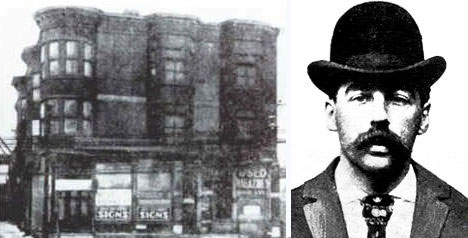
It’s impossible to look at a building connected to H.H. Holmes without thinking about his Murder Castle, where the most abhorrent of his deeds were committed. Shirley Jackson once wrote that some houses are born bad. The Murder Castle was rotten all the way to its blueprints. Officially built as a hotel to cash in on the crowds migrating to Chicago for the World’s Fair, the Murder Castle, as it came to be known, was a three-story-tall, block-long edifice at the corner of 63rd and Wallace Streets. Holmes designed it, oversaw its construction, and financed it with funds drawn from various fraudulent schemes and the proceeds of a pharmacology business that he murdered into.
After his eventual capture, the castle was stormed and found to have a more grisly purpose. The hotel was a labyrinth of torture chambers, secret passageways, trap doors, death rooms, body disposal apparatuses, gas chambers, and all manner of depraved constructions for use on the constant supply of diverse victims that only a hotel can offer. It was, in effect, one giant murder weapon.
An unknown arsonist burned the Murder Castle down shortly after Holmes was hanged. A U.S. Post Office now stands there...haunted, if anything in this world is.

Back in Gilmanton, there’s really not much more to say about this oddity (which explains all the tangents I’ve stuffed into the article), which is good, because I’m running out of new modifiers for the perverse. If you go to the town for the specific purposes of seeing the Mudgett House, you might need a palate cleanser afterwards. I suggest heading an hour south to Derry, New Hampshire, to see the birthplace of another American first, Alan Shepard, Jr., who was America’s first man in space.
What a ridiculously wide spectrum of human achievement we’re capable of.
In closing, last week I posted an article that mentioned how much I dig monsters. Serial killers are always called monsters, but, really, only as a metaphor. Truth is, serial killers are human, as much as you or I or your favorite maître d’. And that’s the terrifying part. That you have a favorite maître d’.